F1 vs F1B Goldendoodle: Complete Generation Guide
Last updated: 2026-03-24
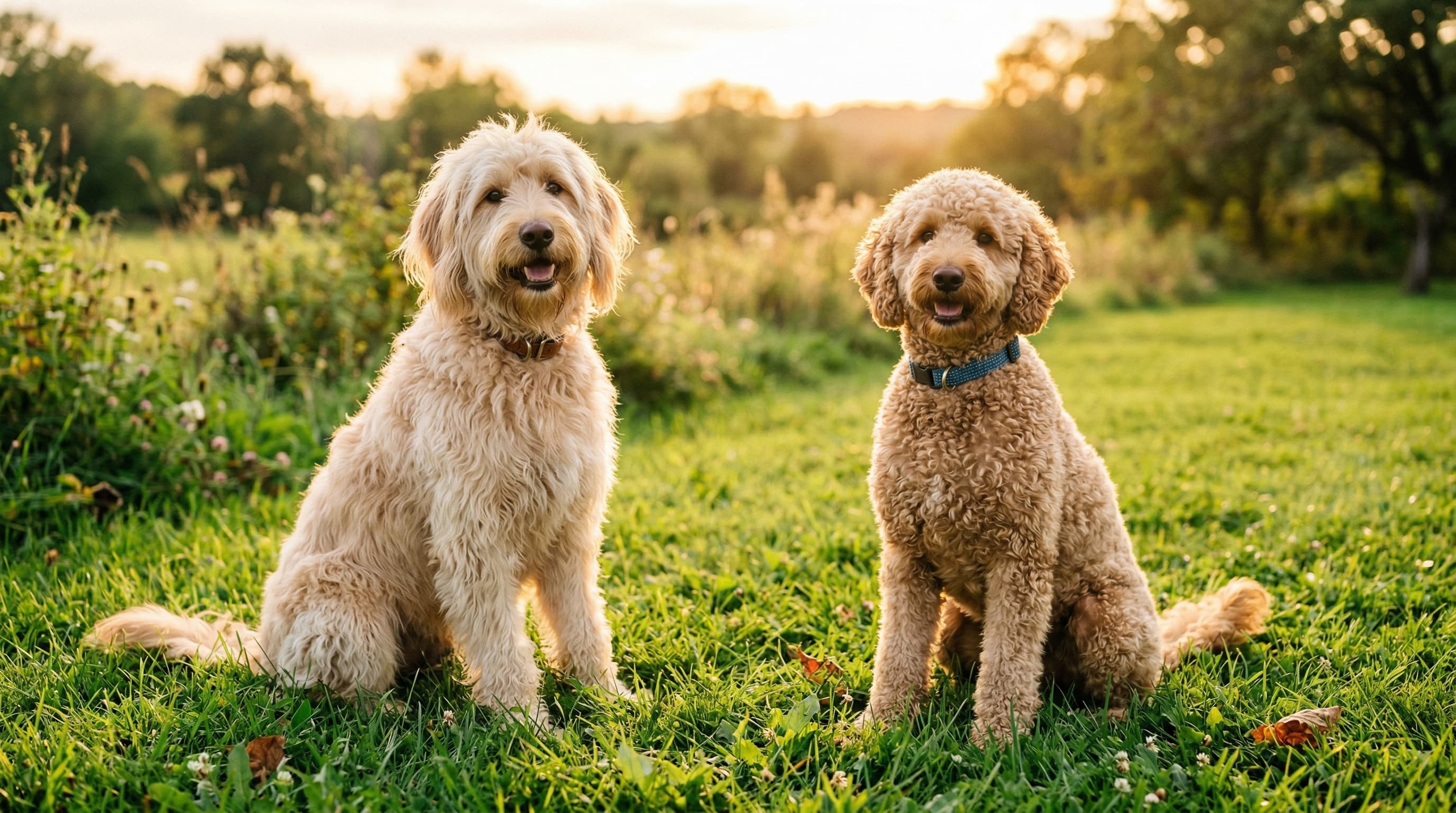
If you're researching Goldendoodle puppies, you've probably come across terms like F1, F1B, F1BB, F2, and Multigen. These designations describe the generation of a Goldendoodle — essentially, how far removed they are from their purebred Golden Retriever and Poodle ancestors. Understanding these generations is crucial because they directly affect coat type, shedding level, size predictability, and even temperament.
In this comprehensive guide, we'll break down every Goldendoodle generation so you can make an informed decision about which type is right for your family. Whether you're looking for the lowest-shedding option, the most predictable size, or the classic "teddy bear" look, generation matters.
What Do the "F" and "B" Mean?
The letter "F" stands for "filial," which simply means "offspring." The number after F indicates which generation of cross the dog represents. The letter "B" stands for "backcross," meaning the Goldendoodle was bred back to a purebred Poodle (in almost all cases) to increase the Poodle genetics in the mix.
More Poodle genetics generally means a curlier, lower-shedding coat — which is why backcross generations like F1B are so popular among allergy sufferers. Let's look at each generation in detail.
F1 Goldendoodle (First Generation)
An F1 Goldendoodle is a first-generation cross between a purebred Golden Retriever and a purebred Poodle. This gives them a genetic makeup of approximately 50% Golden Retriever and 50% Poodle.
F1 Goldendoodles benefit from what geneticists call hybrid vigor (heterosis) — the tendency for crossbred animals to be healthier and more vigorous than their purebred parents. Because the two parent breeds are genetically diverse, their offspring often have fewer inherited health problems than either parent breed alone.
Coat type: F1 coats are the least predictable. They can range from flat and straight (more Golden-like) to loose, wavy coats. Most F1 Goldendoodles have a shaggy, wavy coat that sheds lightly to moderately. They are NOT the best choice if you need a truly low-shedding dog.
Best for: Families who love the classic Goldendoodle look, want maximum hybrid vigor, and don't mind some light shedding. F1 Goldendoodles are wonderful pets, but if allergies are a concern, you may want to consider an F1B or later generation. Learn more about shedding in our guide to Goldendoodle shedding.
F1B Goldendoodle (First Generation Backcross)
An F1B Goldendoodle is the result of breeding an F1 Goldendoodle back to a purebred Poodle. This produces a dog that is approximately 75% Poodle and 25% Golden Retriever.
The F1B is widely considered the most popular Goldendoodle generation, and for good reason. The higher percentage of Poodle genetics produces a curlier, more consistent coat that sheds significantly less than an F1. Most F1B Goldendoodles have wavy to curly coats that are excellent for allergy sufferers.
Coat type: Wavy to curly. Very low shedding. Requires regular grooming — typically a professional groom every 6-8 weeks and daily to every-other-day brushing to prevent matting. See our Goldendoodle grooming guide for detailed care instructions.
Best for: Families with allergies, those who want the classic "teddy bear" Goldendoodle look, and anyone who prefers minimal shedding. The F1B strikes the best balance between the Golden Retriever's friendly temperament and the Poodle's low-shedding coat.
See our available F1B and Multigen Goldendoodle puppies at Doodle Bliss →
F1BB Goldendoodle (First Generation Double Backcross)
An F1BB Goldendoodle is produced by breeding an F1B Goldendoodle back to a purebred Poodle. This results in a dog that is approximately 87.5% Poodle and 12.5% Golden Retriever.
F1BB Goldendoodles have the highest Poodle content of any single-generation cross. Their coats are almost always curly and they shed the absolute least of any Goldendoodle generation. However, with so much Poodle genetics, they may be slightly less "Golden Retriever-like" in temperament — though most owners report they are still wonderfully friendly and affectionate dogs.
Best for: People with severe allergies who absolutely need the lowest-shedding Goldendoodle possible. The tradeoff is a coat that requires the most grooming maintenance and a look that leans more toward the Poodle side.
F2 Goldendoodle (Second Generation)
An F2 Goldendoodle is the result of breeding two F1 Goldendoodles together. Genetically, they are still approximately 50/50 Golden Retriever and Poodle, but their coat types can be highly unpredictable.
Due to how genetics work, F2 Goldendoodles can have a wide range of coat types within a single litter — from completely flat, heavy-shedding coats to tight curls. This unpredictability is why many breeders do not produce F2 Goldendoodles. When choosing a puppy based on coat type, an F2 is the riskiest choice.
Best for: Buyers who are flexible about coat type and shedding level. Not recommended for those with allergies, as there's no reliable way to predict which puppies in an F2 litter will be low-shedding.
F2B Goldendoodle (Second Generation Backcross)
An F2B Goldendoodle is produced by breeding an F2 Goldendoodle back to a Poodle, resulting in approximately 62.5% Poodle and 37.5% Golden Retriever genetics. They offer better coat consistency than F2s while retaining good hybrid vigor.
Best for: A middle ground between F1B and F2 — more coat predictability than an F2, but slightly less consistent than an F1B.
Multigen Goldendoodle
A Multigen (Multi-generational) Goldendoodle is any Goldendoodle that is the third generation or beyond. These dogs come from Goldendoodle-to-Goldendoodle (or Goldendoodle-to-Poodle) pairings where both parents are already Goldendoodles or a Goldendoodle and Poodle.
Reputable breeders who produce Multigen Goldendoodles carefully select for desirable traits — consistent coat type, ideal temperament, proper size, and health-tested parents. The result is often the most predictable and refined Goldendoodle. Multigen litters tend to have very consistent puppies in terms of coat type, size, and temperament. Learn more about the importance of breeder selection in our guide on how to choose a responsible Goldendoodle breeder.
Best for: Buyers who want the most predictable outcome. When you choose a Multigen Goldendoodle from a reputable breeder, you have a very clear picture of what the adult dog will look like, how much it will shed, and how big it will get.
Generation Comparison Table
| Generation | Cross | % Poodle | Shedding | Coat Type | Allergy-Friendly | |------------|-------|----------|----------|-----------|-------------------| | F1 | Golden × Poodle | 50% | Light–Moderate | Straight–Wavy | ⭐⭐ | | F1B | F1 × Poodle | 75% | Very Low | Wavy–Curly | ⭐⭐⭐⭐ | | F1BB | F1B × Poodle | 87.5% | Minimal | Curly | ⭐⭐⭐⭐⭐ | | F2 | F1 × F1 | 50% | Unpredictable | Varies Widely | ⭐⭐ | | F2B | F2 × Poodle | 62.5% | Low | Wavy–Curly | ⭐⭐⭐ | | Multigen | Doodle × Doodle/Poodle | Varies | Low–Minimal | Consistent | ⭐⭐⭐⭐ |
Which Generation Is Right for You?
The "best" Goldendoodle generation depends entirely on your priorities:
- Maximum hybrid vigor: Choose an F1
- Best balance of traits: Choose an F1B — this is the most popular choice for good reason
- Severe allergies: Choose an F1BB or well-bred Multigen
- Most predictable outcome: Choose a Multigen from a reputable breeder
- Budget-friendly: F1 Goldendoodles are sometimes less expensive than later generations
Regardless of generation, always choose a responsible breeder who health-tests their parent dogs. A well-bred F1 from health-tested parents is always a better choice than a poorly bred F1B from untested parents.
Understanding Coat Testing
Modern breeders can now use DNA testing to predict coat type before puppies are even born. Tests like the Furnishings Test (also called the "improper coat" test) can determine whether a puppy will have the desired furnished, non-shedding coat or a flat, shedding coat. The curl gene test predicts whether the coat will be straight, wavy, or curly.
This is especially valuable for F1 and F2 litters where coat variety is highest. A breeder who uses genetic coat testing can match you with the right puppy based on your shedding preferences, even in an F1 litter.
When speaking with breeders, ask whether they test for furnishings and curl genes. It's a sign of a thoughtful, science-based breeding program. Read more about what to look for in our breeder selection guide.
The Bottom Line
Goldendoodle generations are more than just marketing terms — they represent real genetic differences that affect your dog's coat, shedding, and to some degree, temperament. Understanding these differences empowers you to find the perfect Goldendoodle for your family's needs.
For most families, an F1B Goldendoodle offers the ideal combination of low shedding, the beloved teddy bear appearance, wonderful temperament, and good genetic diversity. If allergies are a major concern, look at F1BB or Multigen options. And if you love the idea of a true 50/50 cross with maximum hybrid vigor, an F1 is a fantastic choice.
Ready to meet your future best friend? Browse available Goldendoodle puppies at Doodle Bliss, where every parent is Embark health-tested and every puppy is raised in a loving family home.
🛒 Our Top Picks for Goldendoodle Owners
- Embark Dog DNA Test — The gold standard for breed identification and health screening
- Furminator Undercoat Deshedding Tool — Great for managing seasonal shedding in F1 Goldendoodles
- Chris Christensen Big G Slicker Brush — Essential for all Goldendoodle coat types